Live 3D globe
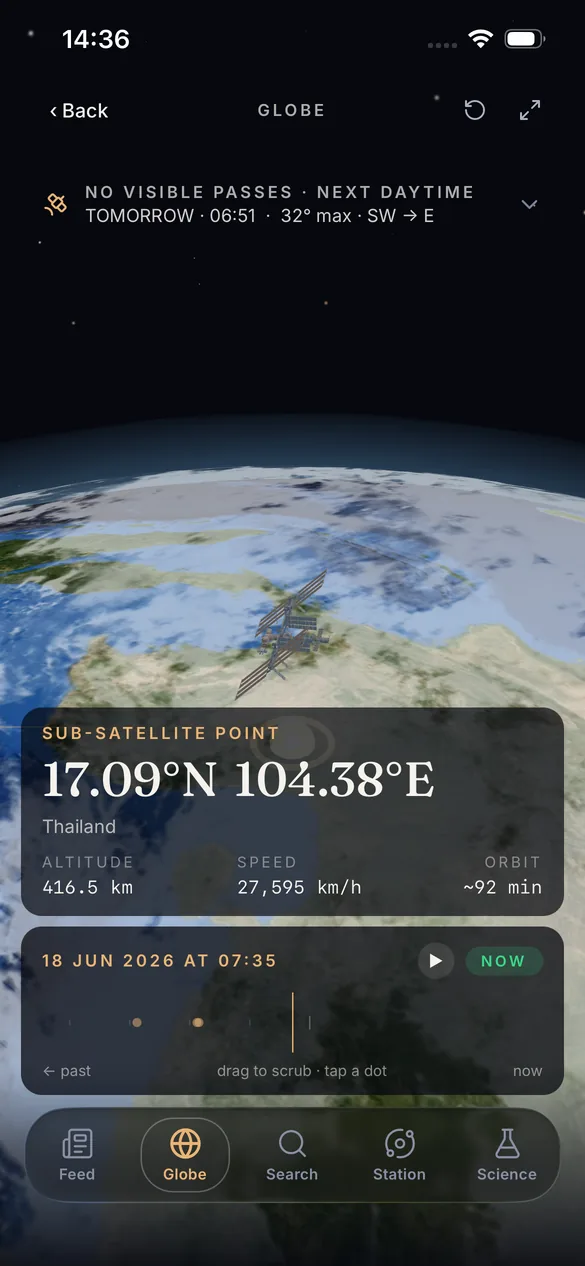
The sub-satellite point in real time - ground track, altitude, speed, and a pin for where you stand.
Out now · iOS & Android
Limited-time launch price. One-time purchase, no subscription.

The sub-satellite point in real time - ground track, altitude, speed, and a pin for where you stand.
The crew’s day in plain words, tied to the point on Earth the station was passing over.
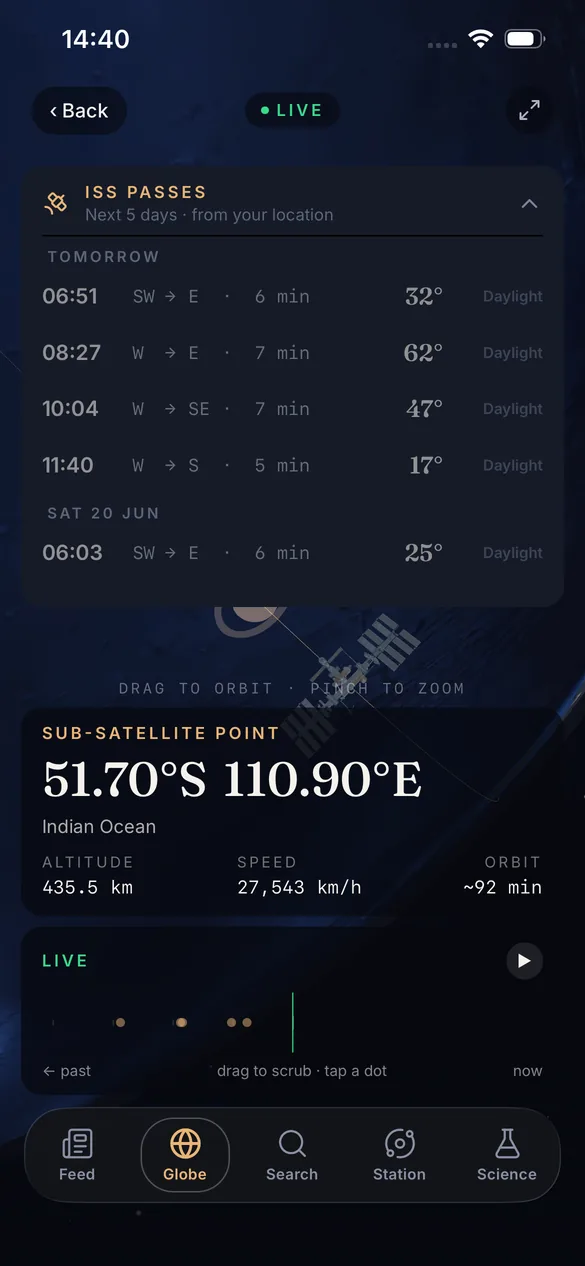
On-device pass prediction for your sky - time, peak elevation, direction and daylight.
Explore modules in 3D, down to the individual rack each experiment runs in.
A plain-English explainer on top of the official NASA record for every experiment.
Expeditions, patches and profiles, plus every docking, undocking and spacewalk.
Where the station is, what its crew did today, which experiments run in which module - and when you can spot it from your own sky.
Now available · iOS + Android
What's inside
A smooth 3D globe locks onto the sub-satellite point, the spot on Earth directly beneath the ISS, with its ground track, live altitude and speed, and a pin for where you stand. Scrub the timeline to wind the orbit back and replay where it has been.
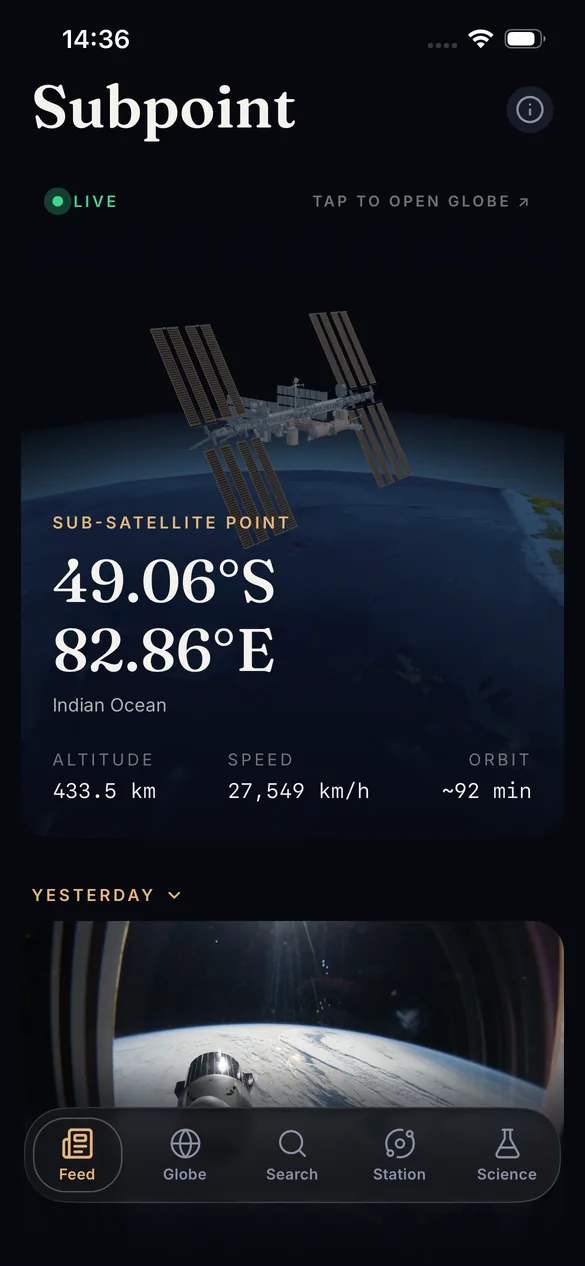
Each day the crew’s work is retold in plain language and tied to the experiments, modules and people involved, and to the exact point on Earth the station was passing over when it happened.
On-device pass prediction from your GPS: upcoming passes with time, peak elevation, direction and whether it is dark enough to see. Your location is used on the phone and never leaves it.
This is not another tracker. Every insight joins at least two axes: when something happened and where the ISS was, which experiment ran in which module, and how a discipline rises and fades across the expeditions.
A peek at the app
Live tracker
A 3D globe pinned to the sub-satellite point, the exact spot on Earth directly under the ISS, with live altitude, speed and orbital period. Drag the timeline to wind the orbit backward and watch the ground track unspool behind it.
Today, aboard
The day’s work in plain language, anchored to where the station was when it happened. Tap any entry to read what the crew actually did, from protein-crystal growth to spacewalk prep, with the experiments and people linked.
Spot it
On-device pass prediction from your own location: a list of upcoming passes with time, peak elevation, direction and daylight, so you can step outside and catch the ISS crossing your sky. Your location never leaves the phone.
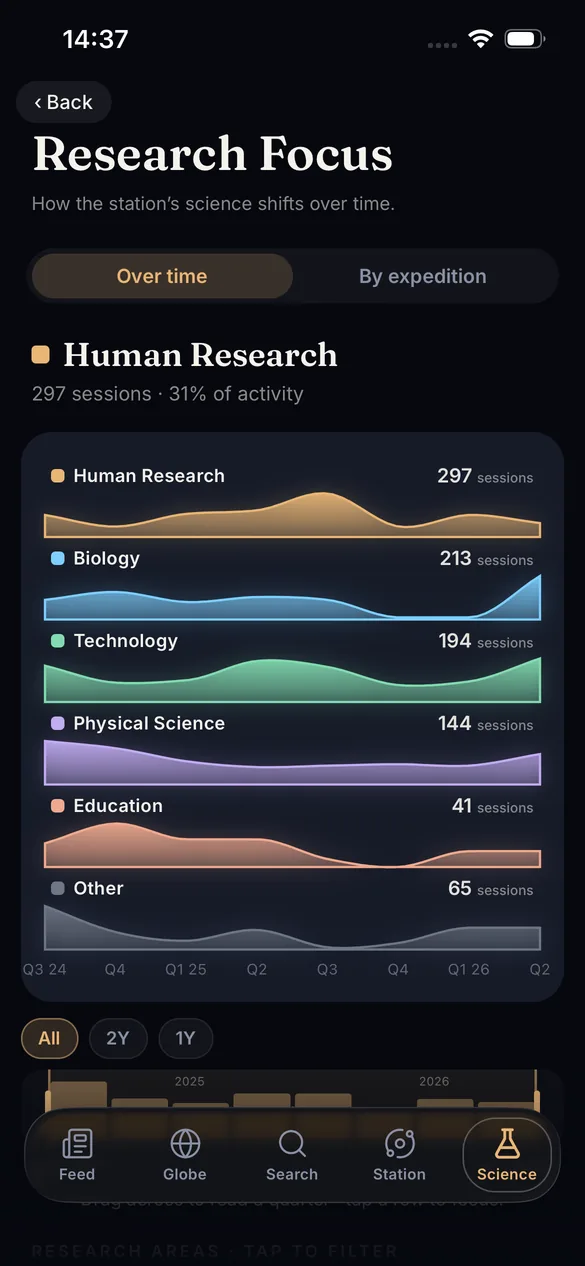
Research focus
A flowing chart of how research focus moves over the mission. Sweep across a month to read its mix of disciplines, or drill in by expedition to see where the lab’s attention went, biology one season, materials science the next.
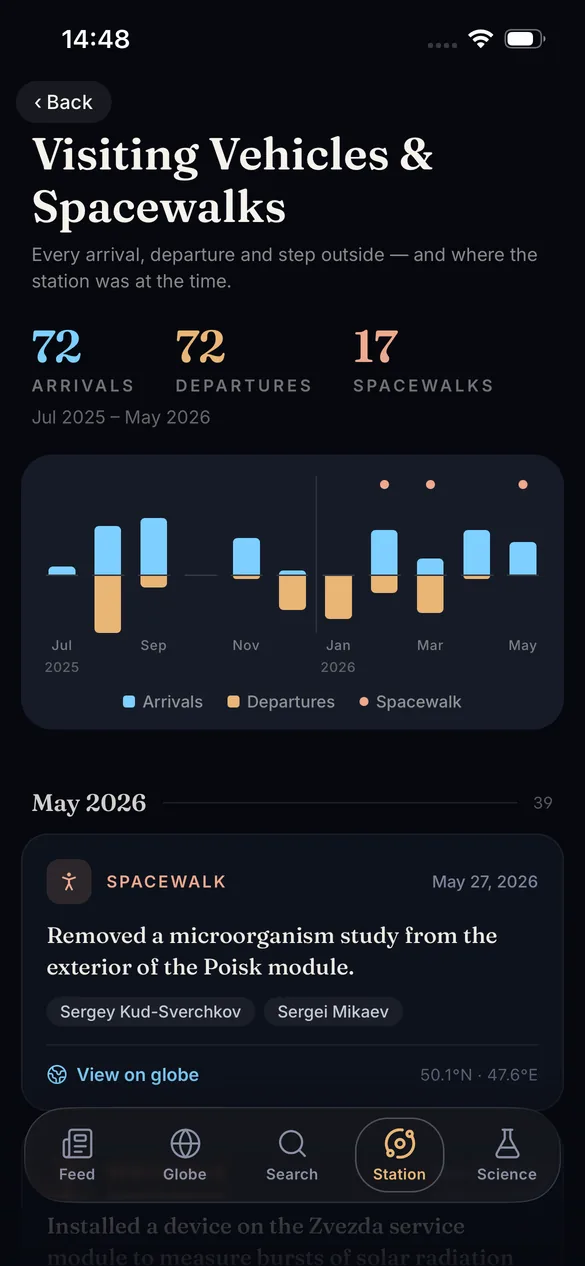
Comings & goings
A running timeline of the station’s traffic: cargo and crew ships docking and undocking, and every spacewalk, each tied to the point on Earth it happened over. Tap one to jump the globe to that exact moment in orbit.
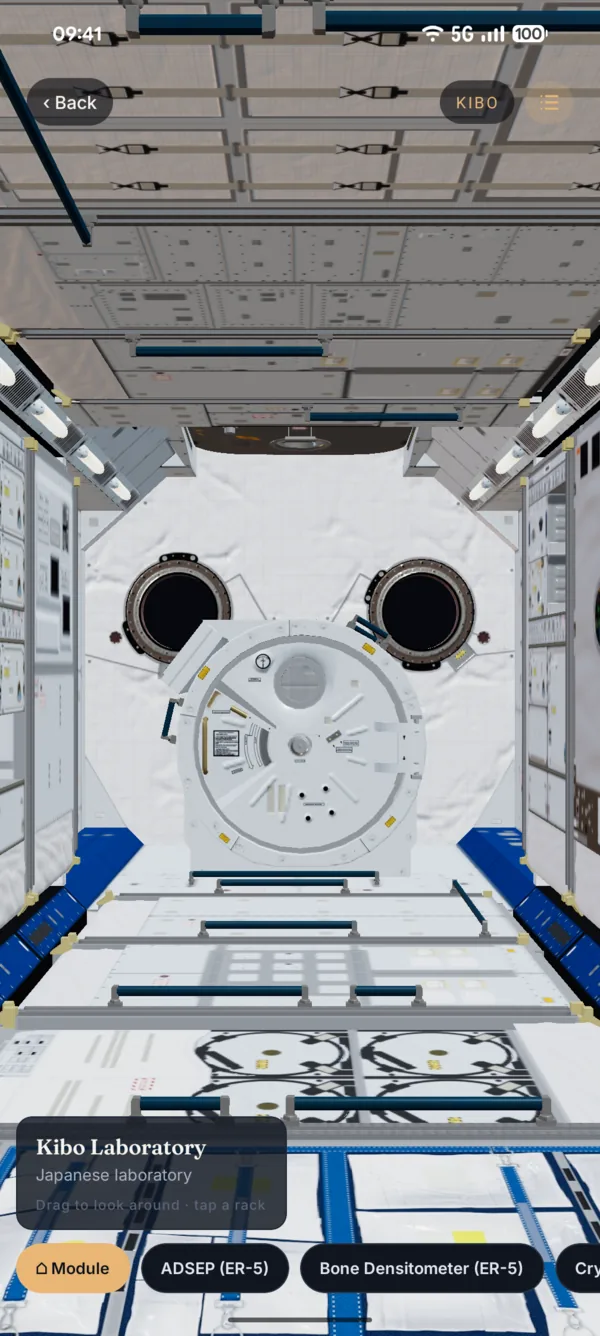
Module view
Explore the ISS one module at a time in 3D, here the Japanese Kibo laboratory, turning freely so you can see how the pieces fit together and which research lives where.
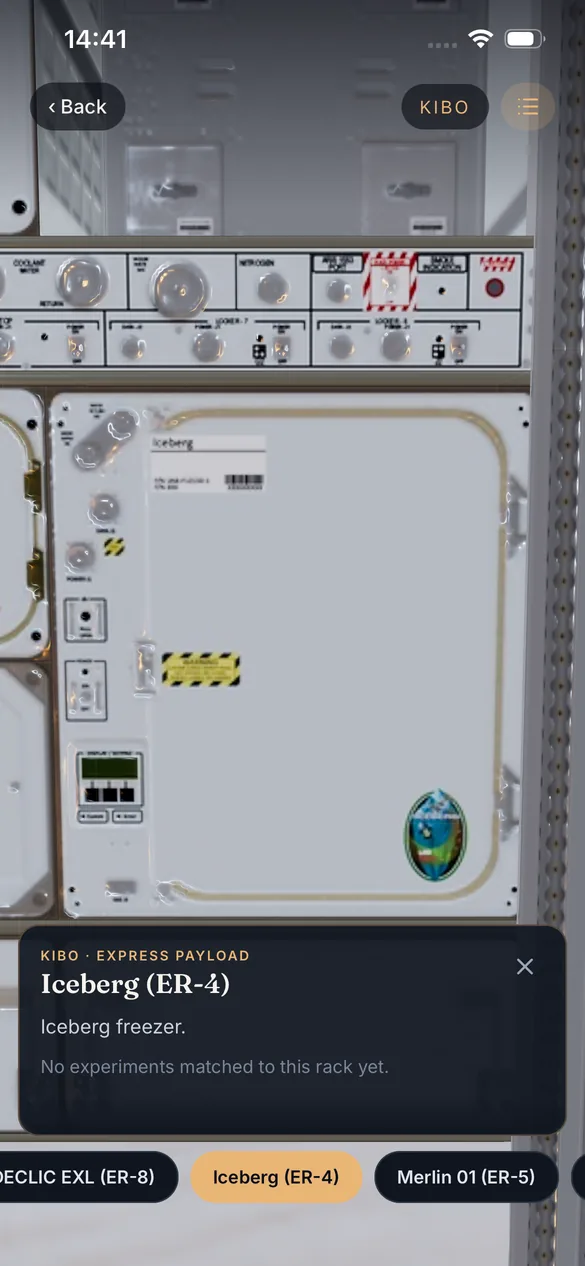
Down to the rack
Go deeper than the module. Subpoint maps experiments to the individual racks they run in, so you can see not just which lab a study sits in, but the precise place on the wall it occupies.
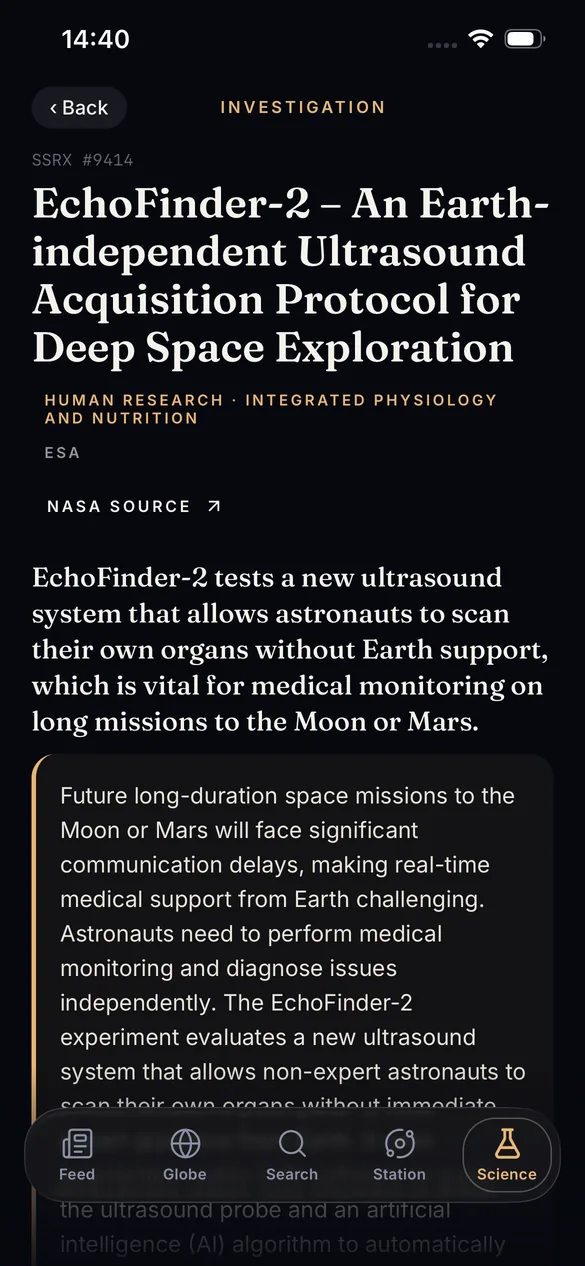
Experiment detail
Every experiment gets a plain-English explainer on top of the official NASA record: what it studies, who runs it, the discipline it belongs to, and the modules and crew that have worked on it.
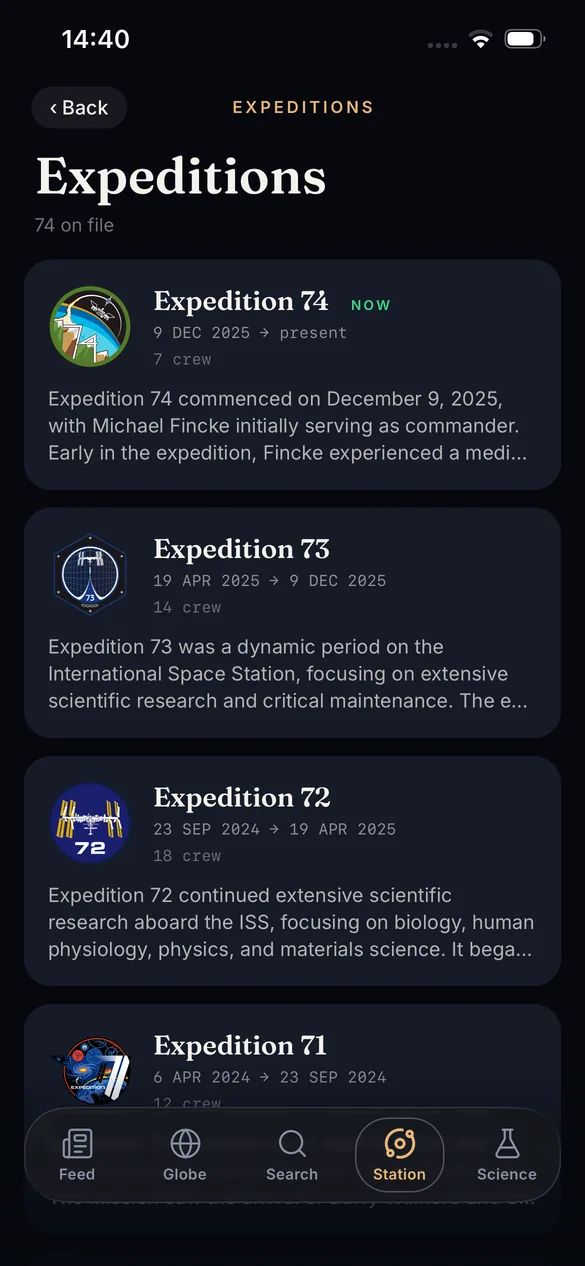
Expeditions & crew
Browse every ISS expedition with its patch, crew, dates and highlights, then open a crew member for their profile: flights, spacewalks, days in orbit and a breakdown of what they spend their time on.
As featured in
What’s different about Subpoint … is that it also tells you what the astronauts are doing. … It’s a great way to see both where the space station is and what’s being done on it.
Mit Subpoint erfahrt ihr … wo sich die Raumstation ISS
gerade befindet, welche Crew gerade an Bord ist und wie die Mitglieder ihren Tag
verbracht haben.
Eine Symbiose aus Live-Tracking, interaktivem 3D-Modul-Atlas und täglichem
Forschungs-Tagebuch der Besatzung … verwandelt
anonyme Orbit-Daten in ein lebendiges, verständliches Weltraum-Erlebnis.
Built on open data
Every source credited with its license; AI-rewritten content (plain-language summaries) is clearly labeled. Nothing here is official - check the original when it matters.
Sources & credits →